Placeholders - ICD-10-CM

Published On - May 06, 2020
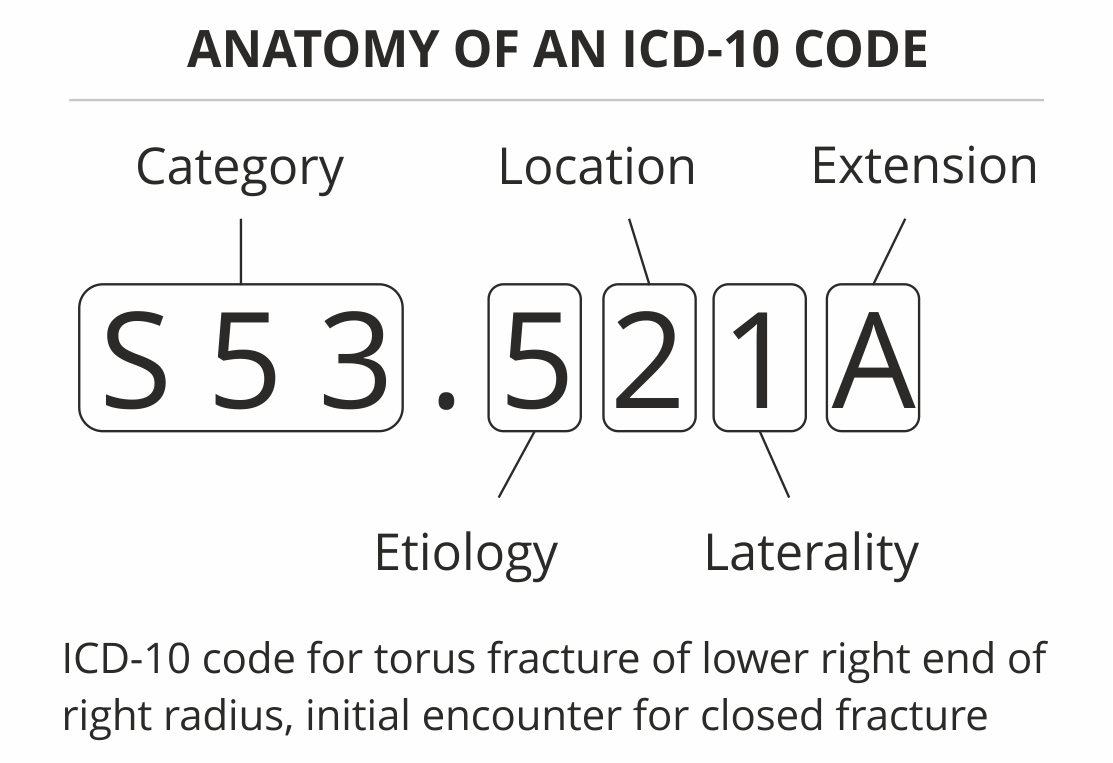
The letter "x” serves as a placeholder when a code contains
fewer than six characters and a seventh character applies. The "x” also
allows for future expansion of the codes. When reporting ICD-10-CM codes, coders must add a placeholder so the
seventh character is in the correct position.
ICD-10-CM has another important convention
that has to do with the code’s extensions. Remember, extensions typically
provide information what encounter this is for the healthcare provider with the
patient. These are not always included, but in the case that they are, they
cannot simply be appended to the end of whatever code is attached. Extensions are only found in the seventh
character of an ICD-10-CM code.
If a coder
has to include an extension for an initial encounter on a code that does not
have six characters, they must add placeholder characters. Coders use an ‘X’
for the placeholder digit.
If, for
example, a coder needs to code an instance of poisoning by unintentional
underdosing of antibiotic penicillin, the coder would use T36.0X1A. In this case, the fifth digit is empty, and so we’d use
the placeholder character ‘X.’ Remember that placeholder characters are only
used when an extension is necessary. Most ICD-10 codes do not include an
extension for the encounter.
The
number of characters signifying an ICD-10 diagnosis varies. For example,
when coding for ophthalmic
complications from diabetes, there will be seven characters. But not all of
them mean something.
E11.3211 - Type
2 diabetes mellitus with mild nonproliferative diabetic retinopathy with
macular edema, right eye
<!--[if !supportLists]-->·
<!--[endif]-->The first three characters, describe the type
of diabetes.
<!--[if !supportLists]-->·
<!--[endif]-->The fourth character communicates the
diabetes has complications for an eye (or both).
<!--[if !supportLists]-->·
<!--[endif]-->The fifth and sixth characters show the
specific complication.
<!--[if !supportLists]-->·
<!--[endif]-->The seventh character designates laterality.
Sometimes only one character is needed to
designate a complication but there will always be a seventh character
designating laterality. So when there is a fifth character but not a sixth, use
X as a placeholder as a sixth character.
Write a public review