ICD-10-CM Sequencing Guidelines

Published On - May 20, 2020
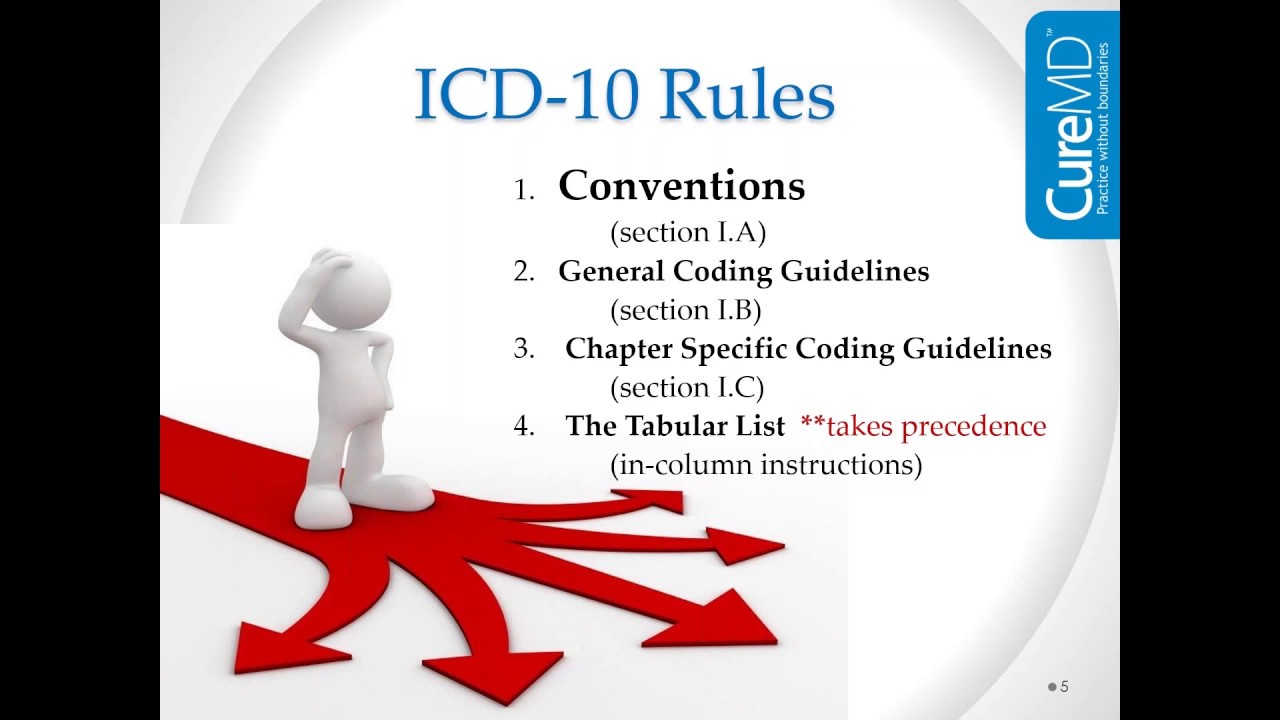
Certain diagnosis codes in ICD-10-CM
are not accepted as a principal or first listed diagnosis.
Coding conventions defined in the ICD-10
manual describe these scenarios. The
term “principal diagnosis” is used on inpatient facility claims and “first
listed diagnosis” is used on
outpatient and professional claims. The term “primary diagnosis” will be used in this document to refer to
either.
Etiology/Manifestation. Certain conditions
have both an underlying etiology and multiple
body system manifestations. Coding conventions require the condition be sequenced first followed by the
manifestation. Wherever such a combination exists, there is a “code first” note with the
manifestation code and a “use additional code” note with the etiology code in ICD-10. In most cases, the manifestation code
will have “in diseases
classified elsewhere” in the code title.
Example: L62 -Nail
disorders in diseases classified elsewhere
Code first underlying disease, such as: Pachydermoperiostosis
(M89.4)L62 is not accepted as
a primary diagnosis because instructions require the underlying condition be coded first.
In addition to the ICD-10 manifestation designation, CMS
identifies manifestation codes for
the Outpatient Code Editor. The CMS manifestation codes may not appear as primary diagnoses on outpatient hospital
claims. CMS updates this list quarterly.
What
does “code first” mean?
There
are certain conditions that have instructional notes in the ICD-10-CM
tabular/coding conventions that guide the coder in sequencing. This is
especially true when the condition has a common manifestation or underlying
conditions of a chronic disease. If there is a “code first” note in the
tabular, the coder should follow this instruction and sequence the underlying
etiology or chronic condition first followed by the manifestation as an
additional diagnosis. There will be a “use additional code” note at the etiology/underlying
condition.
Another
thing to look for is in the code title of specific diagnoses “in diseases
classified elsewhere”. This part of the title is telling the coder that this is
a manifestation code and is never permitted to be sequenced as the PDX or first
listed code. When coders see a code in brackets this indicates that this code
should not be sequenced first.
Sequelae of
Injuries. The
residual or late effect of an injury generally requires two codes. The primary diagnosis must describe
the nature of the sequela. The secondary diagnosis
describes the original injury and usually has an “S” in the 7th position to indicate sequela. (Sequela of
cerebrovascular disease is an exception.)
Example: treatment of
ankle instability following a sprain:
M24.271 -Disorder
of ligament, right ankle
S93.411S -Sprain
of calcaneofibular lig., right ankle, sequela
S93.411S is not accepted as a primary diagnosis
because instructions require the
residual condition be coded first.
Multiple Coding
for a Single Condition. There are some single conditions that require more than one code. Coding instructions in
the ICD-10 manual clearly
indicate which must be coded
first.
Examples:
K52.1 -Toxic
gastroenteritis and colitis
Code first (T51-T65) to identify toxic agent
Z16. -Resistance to anti-microbial drugs
Code first the infection
External Causes
of Morbidity. ICD-10 codes in the
range V00-Y99 are not accepted
as the primary or first listed
diagnosis as they describe the cause
of the morbidity, not the
condition itself.
Etiology: the cause of the disease
Sequela: a condition which is the cause of a previous illness
Morbidity: the condition of being diseased
Manifestation: a symptom
Write a public review