Heart Sounds

Published On - August 07, 2020
What are heart sounds?
Using a stethoscope to assess different
sounds the heart makes is an important diagnostic tool.
Heart sounds are generated by blood flowing
in and out of the heart’s chambers through the valves as they open and close.
Listening to the heart sounds through a stethoscope (auscultation) is one of the first steps a physician takes in
evaluating a patient’s medical condition.
Heart sounds provide the doctor valuable
information about heart function. Auscultation is used to detect abnormal heart
sounds and decide on further course of action.
How does the heart function?
The heart is a muscular organ and has four
chambers that receive and pump blood:
Right atrium
Right ventricle
Left atrium
Left ventricle
The left atrium receives oxygenated blood from the
lungs and pumps it into the left ventricle.
The left ventricle pumps the oxygen-rich blood to the
rest of the body through a network of arteries.
The right atrium receives the oxygen-depleted blood
from the body through veins and pumps it into the right ventricle.
The right ventricle pumps the blood to the lungs for
oxygenation.
The left ventricle’s contractions while
pumping out blood create the systolic blood pressure in the arteries (the
higher number in a blood pressure reading). A web of nerve tissue runs through
the heart to send electric signals to the heart muscle to initiate the heart’s
contraction.
Heart valves ensure that the flow of the
blood is in only one direction, by opening and closing as the heart pumps
blood. The four heart valves are
• Tricuspid
valve separating right atrium and right ventricle
• Mitral
valve separating left atrium and ventricle
• Pulmonic
valve between right ventricle and pulmonary artery
• Aortic
valve between the left ventricle and aorta
What creates the heart sounds?
Blood flow creates vibrations in the heart
chambers and valves which produce audible sounds that can be heard through a
stethoscope. Smooth, low-resistance blood flow is called a laminar flow. When
the flow is rough with high resistance it is known as a turbulent flow.
Vibrations increase along with blood flow
turbulence and depend on the diameter of the blood vessel as well as the
blood’s
• viscosity
• density
• velocity
Some of the functions of the heart that
generate heart sounds are
• Opening
or closing of the heart valves
• Flow
of blood through the valve opening
• Flow
of blood into the heart’s ventricles
• Rubbing
of cardiac surfaces
What are the four heart sounds?
The cardiac cycle is made of two phases:
• Systole
while the ventricles contract to pump out blood
• Diastole
when the ventricles relax and fill with blood.
These two phases constitute the heartbeat.
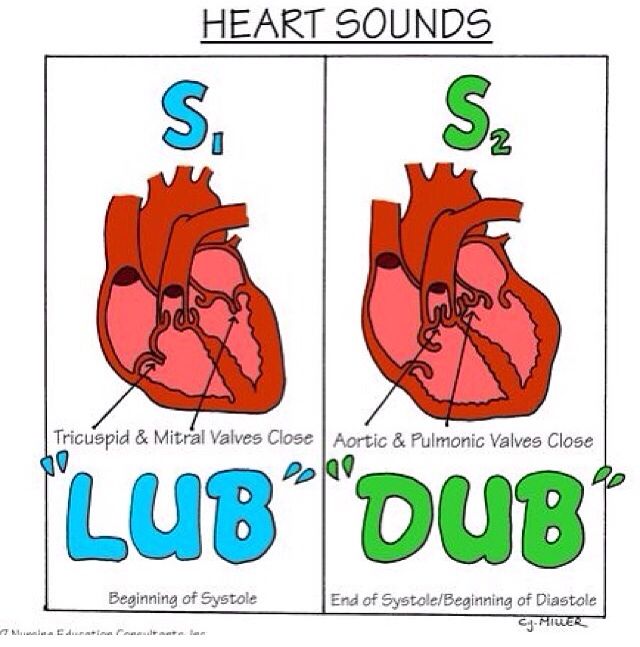
In a healthy adult, the heart makes two
sounds, commonly described as ‘lub’ and ‘dub.’
The third and fourth sounds may be heard in
some healthy people, but can indicate impairment of the heart function. S1 and
S2 are high-pitched and S3 and S4 are low-pitched sounds.
First sound
When the two ventricles contract and pump
out blood into the aorta and pulmonary artery the mitral and tricuspid valves
close to prevent the blood flowing back into the atria. The first sound S1 is
generated by vibrations created by the closing of these two valves.
Normally the mitral valve closes just
before the tricuspid valve, and when the two different sounds are detectable,
it is called a “split S1.” A split S1 may be indicative of certain conditions
affecting the heart.
Second sound
After pumping the blood, the ventricles
relax to receive blood from the atria, and the diastole phase starts. The
aortic and pulmonic valves close and cause vibrations, giving rise to the
second heart sound, S2. The increase in intensity of this sound may indicate
certain conditions.
When the aortic valve closes just before
the pulmonic valve, it may generate a split S2. This may indicate impairment in
the heart function.
Third sound
The third heart sound is a low-pitched
sound audible with the rapid rush of blood from the atrium into the ventricle
as it starts relaxing. This may be a normal sound in some people but in people
with heart conditions, S3 may indicate heart failure.
Fourth sound
The fourth is a low-intensity sound heard
just before S1 in the cardiac cycle. The sudden slowing of blood flow by the
ventricle as the atrium contracts causes this sound, which may be a sign of
heart disease.
Other heart sounds
Opening snap
Opening snap (OS) is a high-pitched sound
that is caused by rapid opening of the mitral or tricuspid valve following the
aortic valve closing sound (S2). This may indicate narrowing (stenosis) of the
mitral or tricuspid valve; the closer in time the OS is to S2, the more severe
the stenosis.
Ejection systolic sounds
These sounds are heard during the early
part of the ventricular contraction, which may be
• Valvular
ejection sounds due to defects in the aortic or pulmonic valves
• Vascular
ejection sounds due to defects of the aortic or pulmonary artery
• Nonejection
systolic click due to mitral or tricuspid valve prolapse
Heart murmurs
In some people, heart murmurs are just the
sound of blood flow characteristic to that person. Doctors call this an
“innocent heart murmur.” Heart murmur may also be caused by turbulent flow of
blood across the heart valves, however, which may indicate heart disease.
Write a public review