7th Character Requirement in ICD-10-CM

Published On - July 16, 2021
7th
Character in ICD-10-CM
Diagnosis
coding brings the unique challenge of knowing when to use a 7th character on
your ICD-10-CM code and then determining which character applies. These tips
will help you refine your diagnosis coding skills.
Tip 1: Don’t Ignore 7th Character Requirements
If
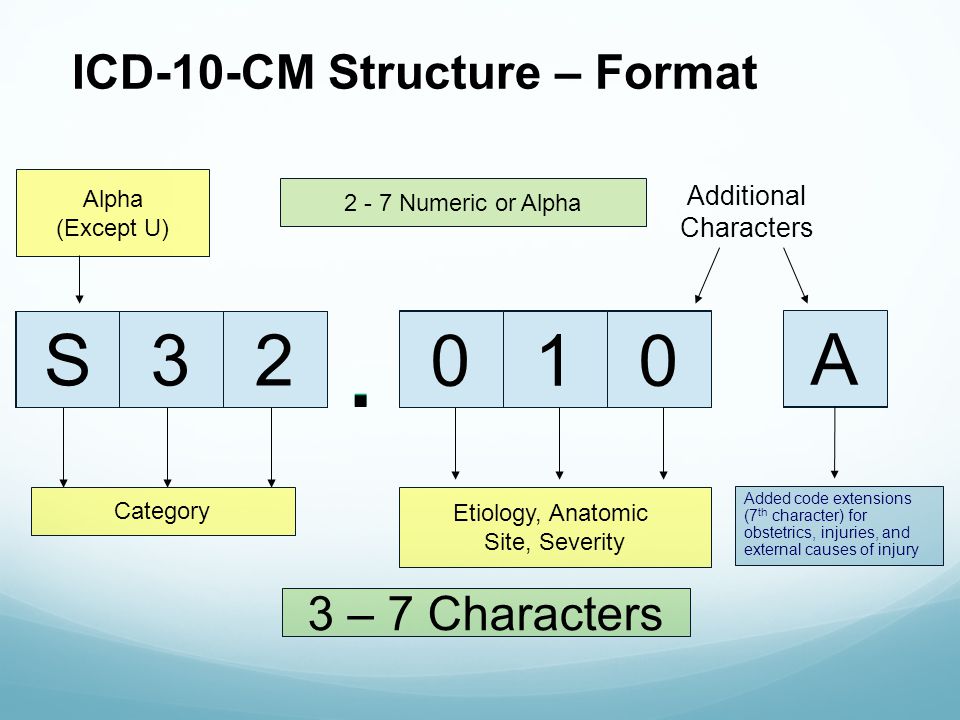
ICD-10-CM indicates a code requires a 7th character, you must report a
seven-character code. Payers will not accept incomplete codes. This tip is an
obvious one, but as Tip 2 and Tip 3 reveal, getting that 7th character on your
code isn’t always simple.’
Tip 2: Know When to Use Placeholder X
ICD-10-CM
uses the placeholder character X in certain codes. You’ll see this in cases
where a code requires a later character in a certain position, but the code
does not have specific characters for one or more places before that character.
By using a placeholder, the ICD-10-CM code set gives itself room to expand
later.
That
placeholder explanation will be a lot clearer with an example. All codes in
category T36.- (Poisoning by, adverse effect of and underdosing of systemic
antibiotics) require a 7th character. ICD-10-CM does not include a 5th
character option for T36.1- to T36.8-, but those subcategories do have 6th
character options. For instance, note the placement of X in T36.0X5A (Adverse
effect of penicillins, initial encounter).
Tip 3: Be Persistent With the 7th Character Search
Many
ICD-10-CM resources list the requirement for 7th characters and the options for
those characters at the category (three-character) level. There may be no
indication at any of the subcategory levels that you need to use a 7th
character.
To return
to our T36.0X5A example, many resources, including the official release on the
Centers for Disease Control and Prevention (CDC) ICD-10-CM site, list the 7th
character requirement at the level of T36. There is no reference to a 7th
character with T36.0, T36.0X, or T36.0X5.
If
possible, choose an ICD-10-CM resource that informs you of additional code
requirements at each level so that you don’t have to spend time hunting for
them. Easy access to 7th character requirements will also reduce your risk of
claim issues from incomplete codes.
Tip 4: Get Familiar With Your Likely Options
Many
categories that require a 7th character have these three options:
• A, initial encounter
• D, subsequent encounter
• S, sequela
For
definitions of those terms, see Tip 5.
Tip 5: Turn to Official Guidelines for 7th Character Explanations
The
definitions of the terms used for 7th characters are not self-evident, but
reading the relevant sections in the ICD-10-CM Official Guidelines can help you
grasp the intent of these characters.
For
instance, Section I.C.19 describes proper 7th character use for codes in
ICD-10-CM Chapter 19, which includes diagnosis codes for injury, poisoning, and
other consequences of external causes.
Use 7th
character A, initial encounter, “for each encounter where the patient is
receiving active treatment for the condition.” The takeaway there is that
“initial” does not always mean “first” for ICD-10-CM 7th characters. Any visit
during active treatment can have 7th character A, regardless of whether it is
the first time the provider saw the patient.
Use 7th
character D, subsequent encounter, “for encounters after the patient has
completed active treatment of the condition and is receiving routine care for
the condition during the healing or recovery phase.” When a code has an option
for a subsequent encounter 7th character, you should use that character instead
of reporting an aftercare Z code.
Use 7th
character S, sequela, “for complications or conditions that arise as a direct
result of a condition, such as scar formation after a burn. The scars are
sequelae of the burn.” You should first report a code for the sequela (like the
scar) and then report the injury code with 7th character S.
Tip 6: Add to Your Choices for Fractures
Categories
for traumatic fractures have additional 7th character values, so don’t slap an
A, D, or S on the end of a fracture code and assume you’ve got it right.
As an
example, S72.- (Fracture of femur) has these 7th character options:
• A, initial encounter for closed fracture
• B, initial encounter for open fracture
type I or II
• C, initial encounter for open fracture
type IIIA, IIIB, or IIIC
• D, subsequent encounter for closed fracture
with routine healing
• E, subsequent encounter for open
fracture type I or II with routine healing
• F,
subsequent encounter for open fracture type IIIA, IIIB, or IIIC with routine
healing
• G, subsequent encounter for closed
fracture with delayed healing
• H, subsequent encounter for open
fracture type I or II with delayed healing
• J, subsequent encounter for open
fracture type IIIA, IIIB, or IIIC with delayed healing
• K, subsequent encounter for closed
fracture with nonunion
• M, subsequent encounter for open
fracture type I or II with nonunion
• N, subsequent encounter for open
fracture type IIIA, IIIB, or IIIC with nonunion
• P, subsequent encounter for closed
fracture with malunion
• Q, subsequent encounter for open
fracture type I or II with malunion
• R, subsequent encounter for open
fracture type IIIA, IIIB, or IIIC with malunion
• S, sequela
Tip 7: Search the Official Guidelines to Learn More
The
definitions from Tip 5 aren’t the only 7th character helpers in the ICD-10-CM
Official Guidelines. You can use the table of contents and the “find” function
on your computer to help you locate relevant information.
For
instance, a search for “sequela” makes it easy to see that the ICD-10-CM
Official Guidelines have distinct sections covering sequelae of complication of
pregnancy and sequelae of cerebrovascular disease. A search for “fracture” will
take you to the rules specific to fracture coding, including use of 7th
characters when appropriate. You’ll discover crucial rules, such as, “The appropriate
7th character for initial encounter should also be assigned for a patient who
delayed seeking treatment for the fracture or nonunion,” and “When the Gustilo
classification type is not specified for an open fracture, the 7th character
for open fracture type I or II should be assigned (B, E, H, M, Q).”
Write a public review