Burns Coding Guidelines

Published On - January 19, 2024
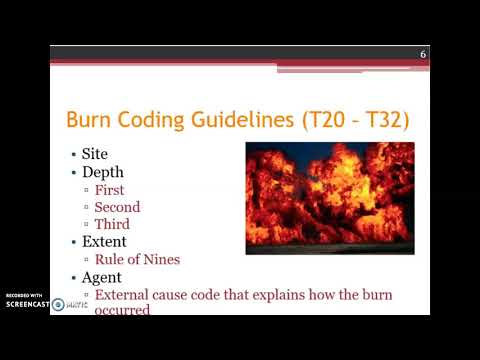
The more familiar you are with burn
injuries and documentation, the easier it is to code the cases.
Burn
coding is challenging and requires you to consider multiple factors. Proper
coding and documentation require an understanding of the types of burns, estimating
burn extent based on age, and being familiar with how this estimation varies
when coding for ICD-10-CM or CPT®.
Approximately
every minute, someone in the United States sustains a burn injury serious
enough to require treatment. According to the American Burn Association, an
estimated 486,000 hospital admissions and visits to hospital emergency
departments occur annually for burn evaluation and treatment in the United
States. This statistic does not account for burn injuries treated in hospital clinics,
private medical offices, or community health centers. The likelihood for a
medical coder to code a burn case is extremely high. Here’s what you need to
know.
How do you Define a Burn?
A
burn is tissue damage with partial or complete destruction of the skin caused
by heat, chemicals, electricity, sunlight, or nuclear radiation. Scalds from
hot liquids and steam, building fires, and flammable liquids and gases are the
most common causes of burns. Inhalation injury, another type of burn, results
from breathing smoke. Keep in mind, ICD-10-CM differentiates between burns and
corrosions; however, the ICD-10-CM guidelines are the same for both.
Types of Burns
- Thermal burns are caused by
an external heat source such as fire or hot liquids in direct contact with
the skin, causing tissue cell death or charring.
- Electrical burns happen when the
body makes contact with an electric current. Electrical burns can be more
extensive than what is seen externally, often affecting internal tissues
and muscles.
- Radiation dermatitis is a
type of dermatitis resulting from exposure of the skin, eyes, or internal
organs to types of radiation. Causes include exposure from sources such as
Cobalt therapy, fluoroscopy, welding arcs, sun exposure, and tanning bed
lights.
- Corrosions are chemical
burns due to contact with internal or external body parts caused by strong
acids such as bleach and battery fluid, or strong bases (alkalis) such as
ammonia, detergents, or solvents.
Burns
are defined by how deep they are and how large an area they cover. A large burn
injury is likely to include burned areas of different depths. Deep burns heal
more slowly, are more difficult to treat, and are prone to complications such
as infections and scarring.
Degrees of Burns
Burn
severity is classified based on the depth of the burn. There are six degrees of
burns (see Figure 1 for corresponding skin depth):
- First-degree
burns damage the outer layer (epidermis) of the skin. These burns are
usually dry, red (erythematous), and painful and usually heal on their own
within a week. A common example is a sunburn.
- Second-degree
burns indicate blistering with damage extending beyond the epidermis
partially into the layer beneath it (dermis). When severe, these burns
might necessitate a skin graft — natural or artificial skin to cover and
protect the body while it heals — and they may leave a scar.
- Third-degree
burns indicate full-thickness tissue loss with damage or complete
destruction of both layers of skin (including hair follicles, oil glands,
and sweat glands). These burns always require skin grafts.
- Fourth-degree
burns extend into fat.
- Fifth-degree
burns extend into the muscle.
- Sixth-degree
burns extend damage down to the bone.
Many
patients suffer from burns in multiple anatomical locations. When coding these
cases:
- Assign a
separate code for each location with a burn.
- If a patient has
multiple burns on the same anatomical site, select the code that reflects
the most severe burn for that location.
- Sequence the
codes in order of severity, with the most severe burn listed first.
When
a patient has both internal and external burns/corrosions, the circumstances of
admission govern the selection of the principal diagnosis (i.e., first-listed
diagnosis).
When a patient is admitted for burn injuries and other related conditions, such
as smoke inhalation and/or respiratory failure, the circumstances of admission
govern the selection of the principal diagnosis.
Code Using the Rule of Nines
ICD-10
burn codes are reported by body location, depth, extent, and external cause,
including the agent or cause of the corrosion, as well as laterality and
encounter. To code burn cases correctly, specify the site, severity, extent,
and external cause.
You need at least three codes to properly report burn diagnoses:
<!--[if !supportLists]-->1.
<!--[endif]-->First-listed code(s): Site and severity (from categories
T20-T25)
- Your
first-listed code will be a combination code that reports both the site
and severity of the injury. The site refers to the anatomical location
that is affected by the burn or corrosion. Code descriptions in the
T20-T28 range first define a general part or section of the human body.
- The fourth
character for each category identifies the severity (except categories
T26-T28). Using the layers of the skin, the severity of a burn is identified
by degree.
- The fifth
character enables you to report additional details regarding the
anatomical site of the burn.
- The sixth
character represents laterality.
<!--[if !supportLists]-->2.
<!--[endif]-->Next-listed code: Extent (from code category T31/T32)
- Burns and
corrosions are classified according to the extent or percentage of the
body surface involved.
- Total body surface area (TBSA) involved
is reported using a code from T31 for a burn or T32 for corrosion, based
on the classic “rule of nines,”
- The rule of
nines for adult patients assigns 1 percent of TBSA to the genitalia and
multiples of 9 percent to other body areas (9 percent for the head, 9
percent per arm, 18 percent per leg, etc.).
- A modified rule
of nines is applied for infants to account for their relatively larger
head (18 percent) and smaller legs (14 percent, each).
- The required
fourth character identifies the percentage of the patient’s entire body
affected by burns.
- The fifth
character identifies the percentage of the patient’s body suffering from
third-degree burns or corrosions only.
<!--[if !supportLists]-->3.
<!--[endif]-->Additional code(s): External cause code(s)
ICD-10-CM
guidelines recommend reporting appropriate external cause codes for burn
patients. Not all payers accept these codes, however.
- External cause –
To identify the source, place, and intent of the burn.
- Agent – To
identify the chemical substance of the corrosion.
Rule of Nines for
children
Rule of Nines for adults
CPT® Coding with Lund-Browder Classification
Codes
to report local treatment of burns, and many skin grafting procedure codes,
specify the TBSA treated. CPT® utilizes the more precise Lund-Browder
classification method to calculate TBSA for burns and grafts. Lund-Browder
divides the body into 19 distinct areas and specifies six different age groups
to account for the changes in body composition during development into
adulthood.
The CPT® code book contains a Lund-Browder classification method chart, as
shown in Table 1, for easy TBSA calculation by body area and patient
age.
Lund-Browder Classification Method
Chart?Table 1
|
Area |
Birth-1
year |
1-4
years |
5-9
years |
10-14
years |
15
year |
Adult |
2nd
degree |
3rd
degree |
Total |
Donor
areas |
|
Head |
19% |
17% |
13% |
1% |
9% |
7% |
||||
|
Neck |
2% |
2% |
2% |
2% |
2% |
2% |
||||
|
Anterior
trunk |
13% |
13% |
13% |
13% |
13% |
13% |
||||
|
Posterior
trunk |
13% |
13% |
13% |
13% |
13% |
13% |
||||
|
Right
buttock |
2.5% |
2.5% |
2.5% |
2.5% |
2.5% |
2.5% |
||||
|
Left
buttock |
2.5% |
2.5% |
2.5% |
2.5% |
2.5% |
2.5% |
||||
|
Genitalia |
1% |
1% |
1% |
1% |
1% |
1% |
||||
|
Right
upper arm |
4% |
4% |
4% |
4% |
4% |
4% |
||||
|
Left
upper arm |
4% |
4% |
4% |
4% |
4% |
4% |
||||
|
Right
lower arm |
3% |
3% |
3% |
3% |
3% |
3% |
||||
|
Left
lower arm |
3% |
3% |
3% |
3% |
3% |
3% |
||||
|
Right
hand |
2.5% |
2.5% |
2.5% |
2.5% |
2.5% |
2.5% |
||||
|
Left
hand |
2.5% |
2.5% |
2.5% |
2.5% |
2.5% |
2.5% |
||||
|
Right
thigh |
2.5% |
6.5% |
1% |
8.5% |
9% |
9.5% |
||||
|
Left
thigh |
5.5% |
6.5% |
2% |
8.5% |
9% |
9.5% |
||||
|
Right
leg |
5% |
5% |
5.5% |
6% |
6.5% |
7% |
||||
|
Left
leg |
5% |
5% |
5.5% |
6% |
6.5% |
7% |
||||
|
Right
foot |
3.5% |
3.5% |
3.5% |
3.5% |
3.5% |
3.5% |
||||
|
Left
foot |
3.5% |
3.5% |
3.5% |
3.5% |
3.5% |
3.5% |
||||
|
Total |
Determining a CPT® code for burn treatment requires documentation of the degree
of the burn and the percentage of body area affected. Documenting what is done
during the visit is important because burn coding can be used for a dressing
change or debridement.
Typical
CPT® procedure codes include:
16000 Initial treatment, first degree burn, when no more
than local treatment is required
16020 Dressings and/or debridement of partial-thickness
burns, initial or subsequent; small (less than 5% total body surface area)
16025
medium (e.g., whole face or whole extremity, or 5% to 10% of total body surface
area)
16030
large (e.g., more than 1 extremity, or greater than 10% of total body surface
area)
Note: CPT® code 16000 is for initial treatment of first-degree burns only,
whereas codes 16020, 16025, and 16030 are for initial and subsequent visits for
treatment of second- and third-degree burns.
Burn treatment codes can be used in addition to an office visit; however, the
office visit must be medically necessary and modifier 25 Significant,
separately identifiable evaluation and management service by the same physician
other qualified health care professional on the same day of the procedure or
other service must be appended to the office visit. A separate, medically
necessary office visit might occur; for example, to prescribe medications such
as topical ointments, antibiotics, and pain medications.
Let’s apply these rules with a case scenario:
Example: A 35 y/o cook presents with a second-degree burn to the front
of the left forearm, first-degree burns to multiple sites on the anterior head,
face, and neck, and a third-degree burn of the anterior chest from bubbling hot
oil. He states he was preparing one of his signature dishes and accidentally
poured too much cooking oil into the hot skillet, which splashed up and burned him.
This is his first visit for evaluation of his burns. Debridement and dressings
were applied to the areas affected by second- and third-degree burns.
Always
sequence first the diagnosis code that reflects the highest degree of burn:
T21.31XA Burn of third degree of chest wall, initial encounter, T22.212A
Burn of second degree of left forearm, initial encounter, T20.19XA Burn
of first degree of multiple sites of head, face, and neck, initial encounter.
For extent, add up the anterior left arm (4.5 percent), anterior head and neck
(4.5 percent), and anterior trunk (18 percent), which makes the TBSA burned 27
percent using the rule of nines. The fourth digit of the code indicates TBSA
(27 percent) and the fifth digit indicates the percentage of the body that has
received third-degree burns (18 percent), so the code indicating extent is
T31.21 Burns involving 20-29% of body surface with 10-19% third degree burns.
Lastly,
external cause codes are: X10.2XXA Contact with fats and cooking oils,
initial encounter and Y92.511 Restaurant or cafe as the place of
occurrence of the external cause.
For
coding the treatment, Lund-Browder Classification estimates the total burn area
to be treated at 16 percent, including the partial thickness, left forearm burn
(3 percent) and the full thickness anterior chest burn (13 percent). The
first-degree burn will be erythematous but will not require anything more than
local treatment. CPT® code 16030 indicates dressings and/or debridement of a
large burn (e.g., more than 1 extremity, or greater than 10 percent TBSA)
Write a public review