GCS - Glasgow Coma Scale

Published On - February 07, 2024
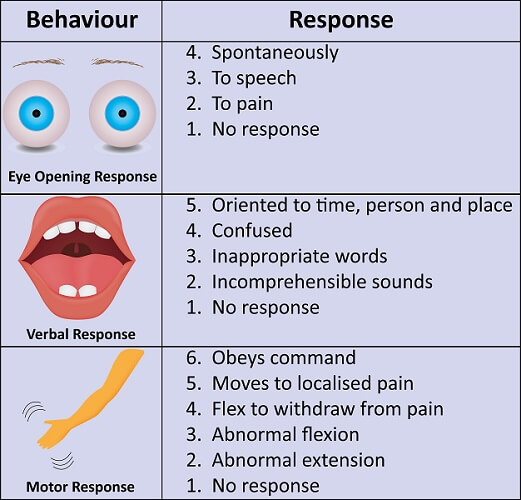
The Glasgow Coma
Scale (GCS) is used to objectively describe the extent of impaired
consciousness in all types of acute medical and trauma patients. The scale
assesses patients according to three aspects of responsiveness: eye-opening,
motor, and verbal responses. Reporting each of these separately provides a
clear, communicable picture of a patient. The findings in each component of the
scale can aggregate into a total Glasgow Coma Score which gives a less detailed
description but can provide a useful summary of the overall severity. The
Glasgow Coma Scale and its total score have since been incorporated in numerous
clinical guidelines and scoring systems for victims of trauma or critical
illness. This activity describes the use of the Glasgow Coma Scale and reviews
the role of using the scale for the interprofessional team to successfully
communicate a patients condition.
Objectives:
- Explain the value of the Glasgow
Coma Scale for patient care.
- Outline the three areas the
Glascow Coma Scales assesses.
- Summarize the severity findings
for each range of the Glascow Coma Scale.
- Review how the interprofessional
team can use the Glasgow Coma Scale to communicate regarding a patients
condition.
Introduction
The Glasgow Coma
Scale was first published in 1974 at the University of Glasgow
by neurosurgery professors Graham Teasdale and Bryan Jennet The
Glasgow Coma Scale (GCS) is used to objectively describe the extent of impaired
consciousness in all types of acute medical and trauma patients. The scale assesses
patients according to three aspects of responsiveness: eye-opening, motor, and
verbal responses. Reporting each of these separately provides a clear,
communicable picture of a patient’s state.
The findings in each
component of the scale can aggregate into a total Glasgow Coma Score which
gives a less detailed description but can provide a useful ‘shorthand’ summary
of the overall severity.The score expression is the sum of the scores as well
as the individual elements. For example, a score of 10 might be expressed as
GCS10 = E3V4M3.
Function
Scoring
and Parameters
The Glasgow Coma
Scale divides into three parameters: best eye response (E), best verbal
response (V) and best motor response (M). The levels of response in the
components of the Glasgow Coma Scale are ‘scored’ from 1, for no response,
up to normal values of 4 (Eye-opening response) 5 ( Verbal response) and 6
(Motor response)
The total Coma Score
thus has values between three and 15, three being the worst and 15 being the
highest.
The score is the sum
of the scores as well as the individual elements. For example, a score of 10
might be expressed as GCS10 = E3V4M3.
Best
eye response (4)
- No eye opening
- Eye opening to pain
- Eye opening to sound
- Eyes open spontaneously
Best
verbal response (5)
- No verbal response
- Incomprehensible sounds
- Inappropriate words
- Confused
- Orientated
Best
motor response (6)
- No motor response.
- Abnormal extension to pain
- Abnormal flexion to pain
- Withdrawal from pain
- Localizing pain
- Obeys commands
Issues
of Concern
The following factors
may interfere with the Glasgow Coma Scale assessment:
- Pre-existing factors
- Language barriers
- Intellectual or neurological
deficit
- Hearing loss or speech impediment
- Effects of current treatment
- Physical (e.g., intubation): If a
patient is intubated and unable to speak, they are evaluated only on the
motor and eye-opening response and the suffix T is added to
their score to indicate intubation.
- Pharmacological (e.g., sedation)
or paralysis: If possible, the clinician should obtain the score before
sedating the patient.
- Effects of other injuries or
lesions
- Orbital/cranial fracture
- Spinal cord damage
- Hypoxic-ischemic encephalopathy
after cold exposure
Write a public review