Blog view

How to apply ICD-10-CM codes

  • Vijayarani Sivakumar
  • Published On - April 02, 2020

    Basically the ICD-10-CM book is divided into 2 sections: Alphabetical Index and Tabular List.

    You will be coding diagnoses, illness, conditions, injury and external causes using ICD-10

    You need to check the disease/illness in the Alphabetical Index first. It will direct you to the correct code. Once you go to the code in Tabular list read all the rules for that code and then carefully choose the correct code. Quite a simple process but just needs some attention!

    ICD-10-CM Guidelines for Coding and Reporting


    Guidelines for coding and reporting with ICD-10-CM are provided by the Centers for Medicare and Medicaid Services (CMS) and the National Center for Health Statistics (NCHS). These guidelines have been approved by the four organizations that make up the Cooperating Parties for the ICD-10-CM: the American Hospital Association (AHA), the American Health Information Management Association (AHIMA), CMS, and NCHS. The conventions of ICD-10-CM take precedence over these guidelines, however.


    Basic ICD-10-CM Coding Steps

    Step 1: Locate the Code

    To locate the code, the coder must find the diagnosis, condition, or reason for visit in the Alphabetic Index and verify the provided code in the Tabular List. The coder has to follow all instructional notes

    Step 2: Assign Code to the Highest Level

    For maximum reimbursement and to prevent claim denials, the coder must assign the code to the highest level of detail. This is accomplished by:


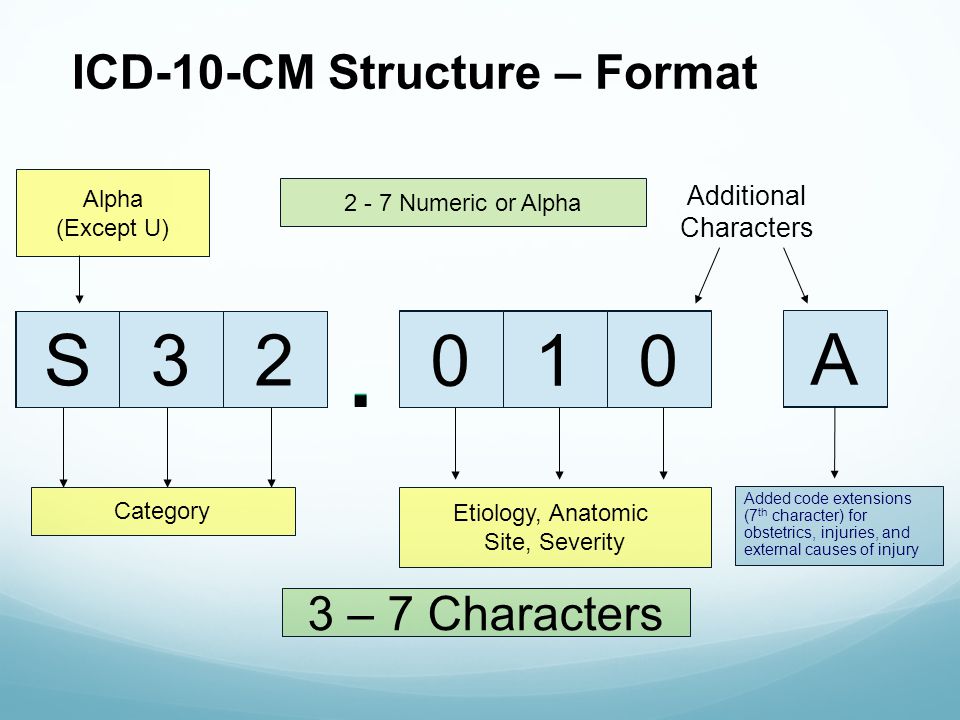
    • Assigning a three-character code only if there are no four-character codes listed.
    • Assigning a four-character code only when there are no five-character codes in that subcategory.
    • Assigning a five-character code only when there are no six-character codes in that subcategory.
    • Assigning a six-character code when one such subclassification is provided.
    • Assigning a seven-character code extension when provided 

    Step 3: Assign Residual Codes

    The use of NEC and NOS (residual codes) as appropriate involves using the main term entry in the Alphabetic Index that is followed by a code number for the unspecified condition. This code is never used when subterms exist that allow for use of a more specific

    Step 4: Assign Combination Codes


    If available, the coder should assign combination codes, which are codes used to classify either two diagnoses with associated secondary process or a diagnosis with an associated complication. Combination codes are listed in the Index and contain connecting words such as "due to," "with," and "associated with"


    Step 5: Assign Multiple Codes


    Multiple coding is the use of more than one code for the identification of certain elements of a complex diagnostic or procedural statement. These statements connect words and phrases by using "with," "incidental to," and "secondary to." Special circumstances related to multiple coding include:

    ·     Mandatory multiple coding – This type of coding is used for "dual classification," which describes the required assignment of two codes to give information about manifestations and/or characteristics and the associated underlying condition, disease, and/or etiology. These codes are found in the Alphabetic Index by the use of a second code listed in brackets.

    ·     Discretionary multiple coding – This type of coding involves "code first" notes that appear in the Tabular List. These notes are under certain codes that are not specifically manifestation or characteristic codes, but codes in which the condition may be due to the underlying condition, disease, illness, or cause. The underlying condition should be always sequenced first with these codes.

    Example: Malignant ascites (R18.0) has a note that specifies "code first" the malignancy, such as malignant neoplasm of ovary (C56.-). For this encounter, code C56.- would be listed first, followed by code R18.0.

    ·     Indiscriminate multiple coding – The coder should avoid indiscriminate coding of irrelevant information, such as codes for characteristics of the diagnosis and codes based on findings of diagnostic tests unless confirmed by the physician.

    Step 6: Code Unconfirmed Diagnosis


    For inpatient admissions that are listed as "possible," "probable," or "questionable," the coder should report as though the diagnosis was established. The exception to this step is when coding HIV infection and influenza due to certain identified viruses, such as avian flu or H1N1 virus 


    Acute and Chronic Conditions (ICD)

    If the same condition is described as both acute and chronic, you should code both and sequence the acute code first

    Fracture Coding / Cast application (CPT)

    Coders should report the CPT code for closed treatment of the fracture only, because cast application is integral to any definitive fracture treatment. The physician may report supplies with the appropriate Q codes.

    If the closed reduction had been performed in the emergency department, the facility would only assign codes for the treatment and the supply, if applicable, but not for the application of the cast.

    Signs and Symptoms (ICD)
    Codes that describe symptoms and signs, as opposed to diagnoses, are acceptable for reporting only when a definitive diagnosis has not been established. When definitive diagnosis has been documented, do not code symptoms.

    Personal History of malignancy (Z85)
    You should use a personal history Z code only when documentation shows there is no evidence of the primary malignancy AND the patient is no longer receiving treatment aimed at that site.

    Diabetes Type (ICD)
    If the type of diabetes mellitus is not documented the default is E11 – Diabetes Mellitus Type 2.

    Dominant vs. Nondominant side
    For ambidextrous patients, the default is dominant
    If the left side is affected, the default is nondominant
    If the right side is affected, the default is dominant.

    Sequela (Late Effects)
    A sequela is the residual effect (condition produced) after the acute phase of an illness or injury has terminated. There is no time limit on when a sequela code can be used.

    Place holder X
    If a code that requires a 7th character is not 6 characters, a placeholder X must be used to fill in the empty characters.

    Displaced vs. Non displaced fracture coding (ICD)
    In ICD-10-CM a fracture not indicated as displaced or nondisplaced should be coded to displaced, and a fracture not designated as open or closed should be coded to closed. While the classification defaults to displaced for fractures, it is very important that complete documentation is encouraged.


    The definition of a pediatric chronic condition is a health problem that lasts over three months, affects the child’s normal activities, and requires many hospitalizations and/or extensive medical care.

    Per ICD-10-CM guidelines, Section 1.C.19.a., 7th character “A,” initial encounter, is used for each encounter where the patient is receiving active treatment for the condition; it does not indicate whether the provider is seeing the patient for the first time.

    Per ICD-10-CM guidelines, Section 1.C.19.c.1, fractures are coded using the appropriate 7th character for subsequent care encounters after the patient has completed active treatment of the fracture and is receiving routine care for the fracture during the healing or recovering phase.

    Conventions are like grammar rules in a language

    General coding guidelines – applied to all the codes in the ICD book

    But all the rules may not be applicable for all codes. So Chapter specific coding guidelines are for exceptions – based on body systems –  different specialties

    The Tabular List – it is in columns – instructions in columns (they have more importance) Tabular list rules take precedence always

    NEC – Not elsewhere classified
    Other specified –
    Patient has a condition, but code is missing in the book.
    Doctor is specifically mentioning the organism, but that option is not available in the coding book

    For example J20.8 - Acute bronchitis due to other specified organisms

    NOS – Not Otherwise Specified
    Information is not provided specifically by the doctor – unspecified code

    For example J20.9 - Acute bronchitis, unspecified
    The doctor missed providing the specific organism name, forgot, did not bother to do it, whatever….
    So then you need to go to unspecified code as the specificity is absent.

    Includes:

    What all is included in that particular code
    AND: Means and, either, or
    S33 – Example
    Dislocation and sprain of joints and ligaments of lumbar spine and pelvis

    (Patient may only have sprain of lumbar spine)

    Etiology/manifestation

    Condition first, followed by manifestation code [square brackets]

    Eg.
    Parkinsonism G31.83 [F02.80] = Disease first + Manifestation second
    Etiology code will have a “use additional code” note
    [] Manifestation code will have a “code first” note – also usually says “in diseases classified elsewhere”

    F02 – (code first)

    Brackets () surround the manifestation code in the alphabet index

    Code Also
    Alerts the coder that more than one code may be required to fully describe the condition. The sequencing of the codes depends on the severity and/or or the reason for the encounter
    Primary reason for the encounter should be coded first as primary dx, that should go first. Usually payer looks only at the first or second codes.

    Code First, Use Additional, Code also,
    F02


    Coders can only code it if the doctors document it

    Excludes 1 and Excludes 2
    1 – NOT CODED HERE – example congenital versus acquired condition like congenital absence of a limb versus amputation later on in life (mutually exclusive)

    2 – NOT INCLUDED HERE – you may but not have to
    S33 (Tabular list)
    Strain/sprain – both have different codes
    Strain – muscles affected
    Sprain – ligaments are affected
    M25.65- (hyphen – incomplete code)

    Excludes 2 example
    M25 – stiffness of hip + R26.2 difficulty walking
    May occur together or may not
    You need to add in R26.2 to completely explain the patient’s condition
    Excludes 2 alerts the coder that this condition is not included under this code, but if you need to add it to better explain the situation or relevant, you may do so

    Work backwards from a code to find the relevant instructional notes

    With/without
    Example : G47.1-
    Guidelines state to code to Highest level of specificity – 7 characters

    Invalid/incomplete codes will be denied

    Signs and symptoms are subjective – chief complaint – in the patient’s own words (but not an established dx)

    Objective: If definitive dx is established by the doctor, then signs and symptoms can be left out (R codes)
    R07 – PAIN IN THROAT AND CHEST

    Subjective codes –
    For example, a patient may be unhappy and sad all the time, R45.2
    But if you can confirm depression – then you need not report R45.2 at all. Just report depression, as sadness is part of depression

    Signs and symptoms routinely associated with a disease process should not be added as additional codes.

    Example: R64.84 – Jaw pain – it is always associated with TMJ arthralgia (M26.62)
    Additional signs and symptoms that may not be associated with a disease process should be coded when present:

    Patient was in an accident and sprained the neck:
    Eg.  R11.0 Nausea (it is relevant and okay to report it separately) and S13.4xxA


    Any dx like – probably, suspected, questionable, rule out, working, anything that is indicating uncertainty should not be coded – you can code the symptoms in this case

    Acute and chronic

    Acute should be listed first

    Combination codes:

    2 different dx or dx with a manifestation/complication
    Eg. Diabetes codes ----E10.36
    Sequela –
    Residual effect
    Eg. Paralysis after the cerebral infarction

    Code first the condition being treated and second the illness that caused it

    Impending or Threatened condition (if it is listed in Alphabetic index)

    Examples:
    I20.0, F10.239, I20.0

    Threatened
    O20.0

    Laterality

    1 – right
    2 – left
    Unspecified laterality codes will be denied by payer

    For extremities:
    73030-RT + M67.311
    73030-LT + M67.312


    Placeholder – X

    Initial encounter – Dx – S82.035A
    Subsequent encounter – Dx – S82.035D
    Sequela – Dx – M35.562 + S82.035S

    A – Initial encounter, while patient is receiving active treatment including continuing treatment by the same or different physician
    D – subsequent encounter, routine care during the healing or recovery phase such as aftercare or followup
    S – sequela, complications or conditions that arise as a direct result of the condition, such as a scar formation after a burn

    Which Seventh Character?
    Is the patient receiving active treatment –A
    Is the patient in the middle of a treatment plan (second or third visits) – A
    Has the patient’s condition stabilized – D
    Is the patient receiving supportive care – D
    Is the patient in a healing or recovery phase – D
    Is the patient being treated for a complication that is the direct result of some other condition that is no longer present –S

    Payers likely deny unspecified codes

    Unspecified should be last choice

    Remember:


    Tabular list rules trump all others if contradicted


    TOP COMMENTS