Excludes 1 and Excludes 2 in ICD-10-CM

Published On - May 25, 2022
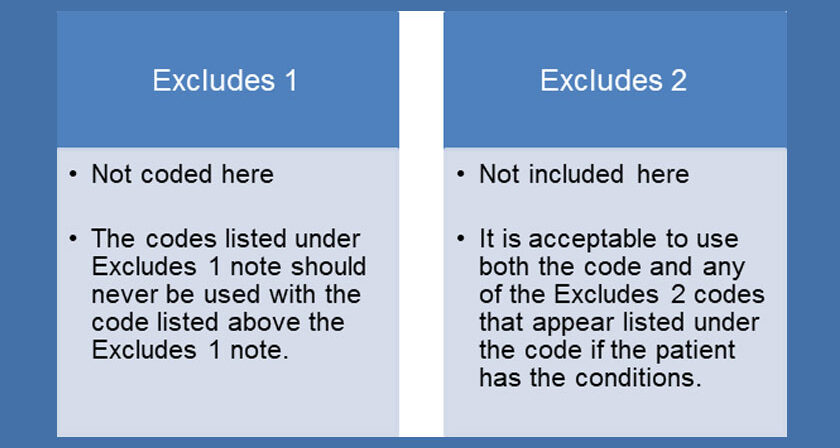
Examples of Excludes 1 and Excludes 2:<!--[if gte vml 1]>
H02.81 – Retained foreign body in eyelid
Excludes1
basics
In
short, ICD-10 includes an Excludes1 note
when two conditions (with separate codes) can’t occur together. The example
given in the 2020 ICD-10-CM Official Guidelines for
Coding and Reporting, effective Oct. 1, 2019, is a congenital form
and an acquired form of the same condition. These notes may appear in places
other than the code level, such as at the three-character category level, so
coders must check for all possible notes that apply to the code.
As
an example, M20 Acquired deformities of fingers and toes is at the
category level. It is not a complete, reportable code. But there are Excludes1
notes at this level, telling you not to report the following conditions and
codes alongside any code beginning with M20:
- Acquired absence
of fingers and toes (Z89)
- Congenital
absence of fingers and toes (Q71.3, Q72.3)
- Congenital
deformities and malformations of fingers and toes (Q66, Q68-Q70, Q74).
The
Excludes2 basics
In
contrast to Excludes1, Excludes2 appears when a code is not appropriate for a
specific condition, and you should look elsewhere to code that excluded
condition. If the patient has both conditions, you may report both codes
together. Again, coders must check all possible places these notes may appear,
such as chapter, block, category, subcategory and code.
As
an example of Excludes 2, I10 Essential (primary) hypertension has a
note that lets you know that if the essential hypertension involves brain
vessels, you should use a code from I60-I69 instead because I10 does not
represent that condition. But if the patient is diagnosed with both essential
hypertension and essential hypertension involving vessels of the brain, it is
acceptable to report both I10 and a code from I60-I69 on the same claim. In the
code set, the note appears like this under I10:
Excludes2:
essential (primary) hypertension involving vessels of brain (I60-I69).
Excludes1
has an exception
When
applied to claims, Excludes1 notes have proved to have some glitches. Excludes1
notes exclude conditions rather than codes from being reported together.
If multiple conditions fall under the same code, then some conditions may merit
Excludes1 while others don’t.
Recognizing
this, the parties that develop ICD-10 explaining that there may be
circumstances when it is appropriate to report two codes together despite being
subject to an Excludes1 note. A version of that exception is now in the
Official Guidelines, I.a.12.a, quoted below:
An exception to the Excludes1
definition is the circumstance when the two conditions are unrelated to each
other. If it is not clear whether the two conditions involving an
Excludes1 note are related or not, query the provider. For example, code
F45.8, Other somatoform disorders, has an Excludes1 note for “sleep related
teeth grinding (G47.63),” because “teeth grinding” is an inclusion term under
F45.8. Only one of these two codes should be assigned for teeth
grinding. However psychogenic dysmenorrhea is also an inclusion term under
F45.8, and a patient could have both this condition and sleep related teeth
grinding. In this case, the two conditions are clearly unrelated to each
other, and so it would be appropriate to report F45.8 and G47.63 together.
Code
1 may have both Excludes1 and Excludes2 for code 2
It
is also possible to find the same code listed in both Excludes1 and Excludes2
notes under a single code because, as explained above, a single code may
represent multiple conditions.
For
instance, J00 Acute nasopharyngitis [common cold] has an Excludes1 note
for rhinitis NOS (J31.0) and an Excludes2 note for chronic rhinitis (J31.0). So
it would be incorrect coding to file a claim reporting J00 for a cold and J31.0
for unspecified rhinitis. But it would be correct to report J00 for a cold and
J31.0 for chronic rhinitis.
Because
of gray areas like the exception and conflicting notes, practices should keep
an eye out for issues with claims related to Excludes1 notes and follow payor
instructions on following up.
Write a public review